Clean-up started Feb 2026
Because it was 2013 written, will take time.
(*- reference original text changed)

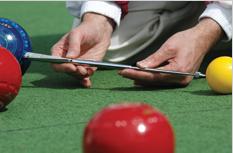 |
| Telescopic Measure Tube |
(Update 2024, with the photo (below) In a recent posted comment on our Ontario Discussion Board by Ralph Ellis, concerning the photo below. (Mr Ellis is a well known Canadian Elite) we find: " This is a Taylor Sonic Measure being used at World Bowls in the 1984. I own one. It is extremely accurate, and an umpire's measure in my games has never disagreed with it. It failed commercially because it was expensive, and lawn bowlers are cheap. It was around $200 in 1980s money or equivalent to $600 today. The only technical drawback was that in strong winds, the measurement would fluctuate for a long time before settling down. Great for indoors or clubs with tree cover to break the wind." (end of update 2024)
 |
| Taylor Sonic Measure |
Of all my blogs since 2012, this March 2013 blog is one of the most visited. ( Photo below) But, like
any idea or method of play, it
is as good as you make it by using it.
Knowing this small unique tricks for measuring your bowls before the end of the game, can have surprisingly accurate results.
 |
| February 23 2026 stats (5605) |
But like any tool you learn and to see results, it is practice which will develop an accuracy and what can become an unbelievable skill. As I was learn my method of measure in Petanque, I at first often made my decision and then did a verification. I had played Petanque several years before coming to Lawn Bowls.
Likewise, I suggest that you verify the measurement of the bowls your "Test Measured" after your end of play even if it is no longer in the final point count. As you develop your confidence in seeing the shot, moving from "I think" to "I know" it will allow for game decisions which will lead to winning more games.
In Westmount's LBC, Montreal Canada, during a Qualification semi finals of the Provincial Single ; I was playing hard but trailing 19-20 of a 21 point game. The marker had said that the two bowls were a measure and because the decision of next bowl (and possibly the last bowl) was important: I walked to the head to know if my opponent had shot. I had to decide if I should attempt a "Tap-back" or a light removal of Andy's bowl or if I drew for shot and accept a 20-20 score, Thinking was, if I missed the tap-back of his bowl and the final measurement gave him the shot; then game was over. At these head examination. the need for a precision evaluation with confidence are usually quickly done, but a bad decision means a game lost.
Because of my experience in the french game of "Petanque" where we can measure which "Petanque ball" is shot at any time; I had several years of experience using a visual method of measuring. With the below mention Visual Measure system, I was able to see that I had shot and only need a draw for 2nd shot to win the game. In "Petanque" if every time the team captain questioned who had the shot; they were to bend and measure the balls; the game would be long and the captains would quickly become tired. I have seen several time in an end of play that it was a close point. So to have a method of visual measurement and have the confidence of your visual skill, the bending and tape measure is not necessary although it is always permitted.
After walking to the head, checking who had shot and returning to the mat I decided I only needed to draw shot (making the questionable bowl a 2nd shot) and the game was won. After the draw, the bowls in question were measured and being close the umpire was called. It was as close as I had thought (within millimeters) but my visual measure had been correct and I went on to the finals against Johnny, who eventually won our game and was that year's Quebec's Single entry in the Canadian Nationals.
The second year lawn bowls student asked me " How do you measure which of two bowls is "Shot" when rules prevent you from any device being placed between the bowl and jack before the end of the game ?". I answered "That is why the Skips get the big money" and went briefly into several methods which a knowledgeable player will use to measure which bowl is shot. However, everyone has their own method and level of confidence in their ability when visiting the head; and after years of games, believe their method allows an accurate decision before the rolling that last bowl of that end of play.
Finger Measure I know you have all seen skips standing with those crossed fingers at the chest as they walks around the head doing their "Quess Measuring" of the bowls. The questions of "How accurate is this method? " is what one might ask. Although I don't use this method often, I will try to explain it.
How does this "Finger Measure" method works ? the idea is simply that looking pass two fingers where have been arranged between the bowls will measure any other bowls in a similar setup if you change position without moving (up or down) the fingers as you move.
Later I will complete this blog by explaining what I believe is more accurate called "Center-to-jack"( found below),
Develop the system you are most comfortable using because accurately knowing the shot before the bowls are measured at the game end can be of a major important. Especially when the decision of that last bowl means a win or a lost, or the wrong decision causes a emotional lost of focus or believe in your ability.
.
 Using the "Spread fingers at the chest" method requires that the Fingers be placed at the inside of the first bowl to be measured and the other finger on the inside of the jack. Now without moving the fingers or the hands' position, while the hands are still sitting on the chest; walk slowly to the next bowl and jack and repeat the same verification. It is important to learn to use a perspective vision of the bowls as indicated a few paragraph after the detail explication of my "90 degree/ Center Line" Method. You will see in that photo that your two eyes see the bowls and jack differently.

Take one measurement by placing the left (or right) finger on the inside of the bowl, and the finger of the other hand to just touching (visually) the jack. Now here is the trick to proper measurement. Use the left eye when checking the left finger touching the bowl and similarly, use the right eye, for the right side when touching the jack. Yes it works quite well. (At this Blog's end is a suggestion for the photo above from NZ photo collection). It is a combination of this finger measurement and my "Center to jack" measurement explained here. Not having used this finger method of measurement I appreciated the readers comments on my suggestion at the end of this blog. He states "I think the finger method needs the toes halfway between the bowl and jack and aligned with an imaginary line. The reason for this is to reduce the variables when you move to compare the next measure.") This method works well if the two bowls and the jack are in a straight line, but what if the bowls and the jack make an angle or so placed that the three each become a point on the triangle's three points.
 |
| Isosceles Right Triangle |
If the diagonal pass directly through the center of the jack then the two side are of equal distance and therefore both bowls are equal distance from the jack.
However, if looking up the diagonal you see your 90 degree line passing to the left or right of the jack then the bowl on the same side as the jack is closer. Eventually with confidence you can see the diagonal pass left or right of center of the jack and know by that small amount, how much one bowl is closer than the other. (a measure judgement which certainly would need an Umpire measure after the end of play is finished.)
One can see this system of measure used when the bowls and jack are not in a straight line . Over the many years of Petanque (even now at 80 I still play it as my indoor winter sport), this measure of shot method has developed. This is my second go-to measurement system, because over the years I have worked at four or five different measurement tricks. (Example the thickness of my finger or thumb being viewed between the bowl and jack).
Learn to apply precision in your various steps of preparation toward the visualization of the actual point. Of course, having confidence in your ability to use this system will lead to strategy decisions with good results. If you have other method, unlike these two measuring system; you will probably be using the one with the most confidence. Often we seek out another measurement system depending upon how the bowls are placed.

First, let us start with basic math. Geometry and the right-angle triangles says that when two triangles are placed with the common side together, then those two opposite sides (left and right) in front of us, create two "right-angle Triangle with the outside edge being of equal distances. So, if the Jack is between the two bowls and clearly a tight measurement, we first start by finding the mid-point. With your center of you shoe equal distance between the bowls being measured. (Forgot about the jack position, as it will be view and used later and also it probably is located at the top (or apex) of the triangle diagram (as in the bottom part of the photo).
This method becomes more difficult when the two bowls are in a straight line with the jack located on that line between the bowls. (in their middle). I often, at these times place my hand in front of me to block or hide the jack. It is important that you find the middle point between the two bowls. Do not place your foot near the jack as this could be consider as using your foot like a measure. If the bowls and jack are close use your thumb or a few fingers to see the closer bowl. Always find a location for the position of your foot away from the jack, possibly you will need to go to the opposite side of jack.
There is an important part of this photo. This apex of the triangle and line of the 90 degrees, up from the base of the triangle, indicates equal when it runs through the "Exact center" of the jack. (if there is the least little difference of this 90 degree line running through the center of the jack, then the ball which is closest to the center side of the jack is the shot, even if a few millimeters. (look at the below example photo of the foot below)
Secondly, To have this method work accurately it is necessary to find the "exact" middle between the two Bowls (or balls if Petanque); so continue to move your foot (as in the photo below) left and right until you are sure you have the middle. You will see eventually that the space on the left and right of your foot are the same distances. (Photo 1 below). If done properly, you will be moving your foot left and then right as you evaluation of the left and right bowl distance from the middle of your shoe. (I wear a black felt mark line on my white bowls shoe for this reason)
 | |
| 2017 Indoor S.Finals |
It may seem difficult but forget about the jack and think of the line between the two bowls and the 90 degrees outward from you where your shoe points.
I am going to mention a problem at this point because it is important. In the sport of petanque the balls are completely round but in lawn bowls the bowls may not be round side pointing toward the jack. (because of the way the bowl is sitting). If it is the Bias side of the bowl facing the jack I allow a few millimeters plus or moin and walk away with a bit of confidence but not total confidence. Actually a member told me the different on the opposite sides of the bias is only a few millimeters.
I am going to mention a problem at this point because it is important. In the sport of petanque the balls are completely round but in lawn bowls the bowls may not be round side pointing toward the jack. (because of the way the bowl is sitting). If it is the Bias side of the bowl facing the jack I allow a few millimeters plus or moin and walk away with a bit of confidence but not total confidence. Actually a member told me the different on the opposite sides of the bias is only a few millimeters.
But if the bowl is sitting on one of the Bias labels then you can be sure the bowls are round. (the running surface is round) (of course this is where the umpire will be measuring it. Although you may, like in photo 2 (below), find it necessary to use different parts of each bowl for your measurement (because of the bias the final measure by the unpire will be that side of the bowl closer to the jack . (Update May 2017 to add photo of Claire Johnston of Scotland during her 2017 Indoor Mixed Pairs Semi-Finals as she is checking which bowl is shot with her foot and this method of measurement. (as it was Game over, the Umpire was called following her verification during this indoor game)
In the pictures below we see that the bowl on the right (measurer left) is closer because one notices that more of the jack is on that side of the 90 degree line. I have learned that, in time and practice, you can see which bowl is shot to within fraction of a jack (In the photo (3) the 90 degree line passes to the left of the centre of the jack, this is the difference in the measure. (1/4 jack width for the bowl on the right) . Remember, the closer the 90 degree line passes to the center of the jack the closer the measurement will be or the distance will be the same)
In the pictures below we see that the bowl on the right (measurer left) is closer because one notices that more of the jack is on that side of the 90 degree line. I have learned that, in time and practice, you can see which bowl is shot to within fraction of a jack (In the photo (3) the 90 degree line passes to the left of the centre of the jack, this is the difference in the measure. (1/4 jack width for the bowl on the right) . Remember, the closer the 90 degree line passes to the center of the jack the closer the measurement will be or the distance will be the same)
When the bowls are both on a straight line which passes near the jack, your evaluation will be easy. .However, the weakness of the method is when the bowls are farther apart and especially when they are at an angle on like with a clock hands at 10:15. (opposite side of the jack ) When practicing this method and for learning, use bowls that are sitting flat so you can better see their positions. In time you will also know how to evaluate those standing bowl and it not affect you when use for the eye to find the mid-distance point of the bowls.

Three different steps are required to accurately use this method of visual bowl measuring.
1 - You must move your foot to the location which is half way between the two bowls to be measured. Take the time to find this center point as it is important. (because of leaning bowls always use the bowl's centre. Maybe even cover the jack with your hand if seeing the jack is a distraction during your find the mid-point.
2. - You then fine tune your evaluation , finding this center point take time to refuse it and re-evaluate it again as you move your foot left and right until you are confident that you have the exact center.
This center point will show you which bowls side is nearest. Known as the Center Point (CP) between the two bowls. This is also the closest point to the jack. (experience and mistakes here will eventually fine tune your judgement )
3. - Having found the point, now look straight up (a 90 degree on that line between the bowls) toward the jack. In the diagram (above) the final photo show the 90 degree passing not though the center of the jack so the bowl on the left is closer. As you get extremely good you can see the center line passing to the left or right of the center of the jack and have confidence in such a fine measure.

I have suggested that you use the left eye for the left finger and when verifying the bowls use the right eye with the right finger; although I think anyone who is always using the same eye would eventually develop a method of verifying the bowl that is shot and have the confidence that their calculation or final decision is correct.
Practice and Development of Measuring skill.
In a non-game practice you can build yourself a double triangle to see the 90 degree from the line from the two bowls. Take two right handed drawing squares (plastic) and tape the short sides together to form a long sided triangle (photo at top of page). The number along the lower side will help you find the half way point. This tool should be only used at the beginning to develop you confidence in your foot placement (in the middle between the two bowls). Using this tool is only suggested to help you to know where to put your foot (mid-way) and verify your method of fine tuning. (moving your foot left and right until you have the ability to find the center point and see the 90 degrees. Always, when practicing this measurement, measure the bowls afterward to know you were correct on your evaluation and decision.
1.After finding your midway point between the two bowls use the tool to verify how accurate you have found the midway point as you use it at wrist high like the finger measurement.(above top photo) Without looking at the jack or the point of the tool toward the jack. place the marked side of the square on the Closest point (CP) of each bowl. Your taped joint should arrive at the place of your shoe and your marked toe spot.
2. After you have decided which bowl is closer, to verify how accurate your are, use the practice tool to check how the 90 degree line compares to your 90 degree to the jack. The tool is only suggested to allow you to have confidence in your judgement. It is by using this practice tool that you will fine tune your ability.
3. Measure the bowls to jack with a Bowls tape and find that you were correct on the closest bowl.
2. After you have decided which bowl is closer, to verify how accurate your are, use the practice tool to check how the 90 degree line compares to your 90 degree to the jack. The tool is only suggested to allow you to have confidence in your judgement. It is by using this practice tool that you will fine tune your ability.
3. Measure the bowls to jack with a Bowls tape and find that you were correct on the closest bowl.
 |
| Update May 25 2017 Stats |
I've added the stats (left) for this blog. After 5 years and over 20,000 views, this blog has been the most popular each week. (was written 11 March 2013) (Later Updated with photo of stats of 2017)
Combined Finger/ Center of Jack Measure
The center to Jack method described above is rather difficult to use when the bowls are on opposite side of the jack, As you see (below) the fingers are too close for a good finger measure; but a combination of the finger measuring and the center to jack method is suggested, as using the above system is helping you develop your confidence .
* Using the above NZ Bowls Photo.and bowls to be sighted here I have attempted to modify the photo to show how it is possible to have a combined sighting method (finger and center of the jack sighting).
 |
| One hand hides the jack while the other hand (finger) finds cehter. Foot placed so 90 deg passes along line. Hand to see how jack fairs to line. |
1 - Place one hand to hide the jack and then sight the centre of the two bowls with your finger without seeing the jack. (a small finger helps)
2 - Placing your foot where the center passes between the two bowls (can even have your mate stand on opposite side of jack and be second position of 90 degree line.
3 - Now remove the hand which is hiding the jack and see how the 90 degree centerline to jack passes through the jack. (or even through the jack..
You should be able to see how the 90 degree line passes to the left or right of the jack. (or even through the jack)
To the left of center mean the that the right side is closest to the jack. (largest half of the jack)
The idea of the center to jack method is to find the center of the two bowls and see how the 90 degree line pass through the jack. But in the photo it is clear you can not put the foot half way between the two bowls to be sighted. So do the next best thing. Place it back away and use an "mind image" of the above mention tool to find the half-way point.
Hope this suggestion helps with skip measuring during game play, but to use the center to jack method requires fine tuning your ability to see that center line. If you use finger measure all the time and then try this at other times, it may not work because you must fine tune your eye to see the center to jack line. (* end)
Good luck , have fun. Re-written Aug 2024
To the left of center mean the that the right side is closest to the jack. (largest half of the jack)
The idea of the center to jack method is to find the center of the two bowls and see how the 90 degree line pass through the jack. But in the photo it is clear you can not put the foot half way between the two bowls to be sighted. So do the next best thing. Place it back away and use an "mind image" of the above mention tool to find the half-way point.
Hope this suggestion helps with skip measuring during game play, but to use the center to jack method requires fine tuning your ability to see that center line. If you use finger measure all the time and then try this at other times, it may not work because you must fine tune your eye to see the center to jack line. (* end)
Good luck , have fun. Re-written Aug 2024

You said "Maritimes Canada has 4 provinces". That is incorrect. Maritimes Canada has three provinces. Newfoundland is one of four Atlantic Provinces.
ReplyDeleteVewwy interesting. But I think the finger method needs the toes halfway between the bowl and jack and aligned with an imaginary line. The reason for this is to reduce the variables when you move to compare the next measure. My other suggestion for bowlers who do not want to get down for an official measure is to use chopsticks instead of fingers. Slide the chopsticks apart to get the visual distance the same as fingers.
ReplyDelete