Thursday, January 22, 2015

Reading Blog Stats

Blogging is expressing your views and experiences to interested readers.  Knowing what is of interest to the readers and visitors to the site depends upon the analysis of the Blog Stats supplied by blogger sites like www.blogger.com.

Two Basic types of readers are found visiting a site. First, the regular who in discovering a new blog has been posted, or on visiting regularly; is a continual follower.  Second is the visitors who arrive due to some search engine and visit several of the blog posting.  As a Blog writer, both are important and should be included in the development of new Blogs.

Regular Blog Visitors To all of us there are many interesting subjects which we would like to share with the readers, however as a blog author I must respect the content type which has drawn my readers. There are several types of Social Media Formats and I use my Twitter to inform my followers about Bowls and news while FaceBook is a more Personal Cyber life.
My Facebook Account
 Having been a Blind Bowls Instructor and Coach over the past several years, I have build a part of my Facebook as .Blind Lawn Bowls  Of course, few Social Media Formats are user friendly to those with Visual Problems.
   Although I attempt to push news and invite participants as administrator to this Blind Bowls FaceBook page; my major objective is to remind the reader that they must tell the Visual Impaired individuals of what they read because few of the computer aids developed for the Blind allow Text and photos mixed.
On my Facebook I wrote "Ready for something strange!!! "A Feeling". On the last day of my 70th year, I found myself being judged and not wanting. We do not know our life until all our experience are bottled like a fine wine. Aging of the wine is all things seen and judged, and great is knowing "One's Value". If you miss understanding one day you we'll know."" because everyday we learn and see more and more of who we are or have been. None of this is Blog worthy unless that has been the subject for the last 5 years.

Blog Statistic Information  The Blog Stats reveal the new visitors and their subject interest which has brought them to the blog.The regular topic of interest has been "Three Subconscious Mind Exercises" written
This Blog's Stats for last 7 Days.
in December 2012. Of course, I should and will write more of these blogs but also my audience are regular lawn Bowler who are searching for information.  Articles like the e-book of Rob Judson, an Australian coach.who In a February 2003 did a  SCRIBD publication " of Lawn Bowl Coaching. A lot of the opinion and views are from my experience in Lawn Bowls, Petanque (French Bowls) and Archery where being in the zone is a major part of perfection of the sport.

The High Blue Peak of 6 or 8 reads is a new visitor whom as followed several other topics after arriving at the site for the search.  It is with satisfaction that I find a regular blog visit of 15 to 25 hits per day. Yes there has been a lot written over the past 5 or more years but these "Hits" are regular and new visitors.  Often when an interested reader finds my blog interesting they attempt to follow the blog by being a follower of my Twitter account.Here in the attach photo we find a request
Springhiler's Twitter Account
for to follow.  I have kept this account locked to prevent the often advertising and non-lawn bowls visitors.  Everyone is welcome and I often visit their twitter accounts for information on the recent news of Lawn Bowls.

Yes, I know that 126 followers is not many but I am sure they are some of the best Lawn Bowls players in the world. Some of the Twitter following are clubs who are doing great things with the youth and the handicap or Visually Impaired.

 Last summer I was excited to find a heavy following from the far East or South Africa. These countries are strong in Long Bowls and of course the "Bowl's Stats" map show me what countries are following.  Of course, if I am not submitting a blog every week the visitors are usually those English countries which find the blog because of a Search Engine.


Two days Later  Looking back at this blog's stats two days later (updated 24th) I learn at about six (6) readers had accessed my Blog for the Twitter entry and regular follower.
Blog Stats after 2 days


Two Days later I find that only 6 views of this blog. The spike in the stats are new readers who have accessed the blog and then read several of the older entries.
  Word of Advice  If you believe in your sport and want it to grow, you must make it a visual part of your life. Yes do great on the green builds interest in your club and region, but the Internet and Social Media has made the world small and we can all reach out and spread the word on Bowls or Blind Lawn Bowls.

Thursday, December 18, 2014

Communication & Team Signals

A request from a Blog Reader was "Will be playing on a ..triples team this coming 2015 season. Could you write something abut team signaling that our members can learn over the winter. Thanks from the GreensBowler"
(Photobucket com)

Is this a Team Signal in the photo (Just on the shoulder of the Pointing Circle)

Here Goes showing some team Signals  ---  With a long time Pairs Partner I did the following Team Signal (will explain it meaning afterward ) First Draft before Christmas plse accept mistakes)

Signal - Open Hand, palm facing Player on the Mat..   Signal - Fingers on Chest show recognize signal for Love   Signal - Requested Forehand Bowl   Signal - Did a Crossed Arm in front of Chest "X"  Signal -Pointed to Opponents Bowl and Drew hand back toward Jack  Signal - Showed Three finger on chest pointing downward  Signal -  Stepped to Jack and Side stepped 18 inches  Signal -  Tapped ankle of foot pointing toward Player  Signal - Made small circle with thumb and forefinger  Signal  - Pointed to Jack and moved hand  back to Bowls behind Jack  Signal - Showed Bowls "Ours"  Signal - Showed four finger on chest  Signal - Made Baseball Safe type Signal (hands crossing body left and right)

First reaction of my partner was hand over his face and turned away from the Mat.  So I did it again all in the sme order and movements.   What I was saying was:
Attention  - Signal  Open Hand Palm toward Player on Mat  - Used to warn Signals coming
I Like     -  Signal  Hand on chest to say Love (Sign Language)    Suggesting I will suggest something.
Forehand - Normal Signal taught by Club to Beginning Players
LOVE (You, It, "L O V E")
Be Careful - Signal  "X" or Do Not Do  to warn of danger.
Not to Roll Opponent Bowl to Jack  - Showed Bowl as Opponent and it movement toward Jack
Giving 3 points  Signal for Points with finger on chest point down.
However - Going to Jack.. Suggesting a change in thought about the Jack
If 18 inches wide - Step side way from jack indicates playing a false jack  (as if the jack was there)
Can Get shot     - Pointing to Ankle of foot indicates where bowl should stop
If jack rolls   - Showing Jack (small circle with thumb and fore finger) and movement sign
Back to Bowls - Showing the bowls as "Ours"
Get 4 points   - Showing points up or gained  (fingers at chest in direction of oppose arm
SAFE - Your Choice - Signal of Baseball which I often use to tell Pointer they have choice of Jack Distance.
Safe or "Your Choice"

Yes a complete conversation but would you have wanted to yell it up the green or demand the player come to the Head and see.  Only a team that plays together would appreciate this conversation but it has some interesting signals.

First before doing a personal or team signal it is best to indicate that such a signal is coming.  (the open palm toward the player) suggesting.. Wait a Minute..  Could be touching your Ear to Say "Listen". But the need to have full attention when doing Team Signals is very important.  In triples it is usually between the skip and mate that this communication happens.
It is clear that this Skip is yelling instructions up the green.(Photobucket.com)
In the photo there are a lot of bowls and teams playing and if each is calling instructions up and down the green it shows a lack of respect for the bowler on the mat.  Sometimes a team is faster playing than another and the skip is on a neighbour green with Bowlers still on the Mat next to him..  Check out Mat players when yelling up and down the green Please
Second, the indication of Points up or down should be a rather invisible signal as sometimes the change in the head makes a big difference and you don't want to bring this to the opponents attention.  Especially if the opponent skip is on the mat and the communication is not that great between them.

Generally the Signals are from the head to the Mat Player however some signals are needed from the Mat, such as "Signals Request for Information".  "Are we up or Down ?" "What Changed ?" Distance from Jack ?" (Circle of thumb and finger and other hand moving away and back to that hand). Remember that reading the body language of the Skip or Mate can also be telling you about the shot.
A turn and walk away from the head with out a "great Bowl" Signal  can mean something went wrong.

Signals should always be Positive Communication or Request.  The Thumbs up for a Good Bowl or Got Shot is encouraging to the player on the mat. Indicating the number of points change when something happens is only polite.  Even with a mistake the player on the mat will think the worst or be worried when next coming to the mat.

Remember that the Skip is in charge and his instructions should not be a request but a direction of order of play. The signals taught to novice players are always instructions and not request. Forehand, Frontal bowl, Back Position.  Also a skip should value the efforts of his team mates and indicate the success of shots and points up or down.

Enjoy and hope you find some ideas in this blog.. 

Sunday, November 23, 2014

Prefection of your Draw Ability

So you are a Good Draw Bowler ? It is nice to be able to draw three of four bowls to within inches of each other during a practice, but a Practice is only as good as your expectation of yourself. "Practice makes perfect" but truth is that "Improving something by Practice, makes Perfect your Practice"

The Draw Shot
  The perfection of the delivery movement to allow the proper weight and line to result in the bowl arriving at the desired position. Drawing to the "Jack" or a position in the "House" around the Jack should be the same effort.  Yes, that big white thing is a great aiming ,"draw to me" incentives, but a position around the jack should be just as easily and also possible for you to do ( Photo from YouTube Delivery 101)

The Pointing Clock

In Blind Bowls (Link NSW Blind Sports Assoc) the athletic is given the results of his delivery by a Point Clock which is the "Jack" being the center and 12 o'clock behind the jack.  "You bowl came to rest at 18 inches and 7 o'clock"

the coach instructs the Blind bowler as his bowls comes to rest. In Visual bowls the Pointing clock can be also used as an indication of the size of the diameter of positions which will still allow your bowls to be shot. A 12 inch frontal bowl allows a "Pointing Clock/ of that size.  If you have already played two bowls and they are both sitting behind the jack at 11 o'clock, your ability to trail the jack should be to play for a point at less than 12 inches behind the jack at 11 o'clock. (left side behind the "Jack".

Why ?  Because you have 22 inches of the Point clock to arrive and make the point.  If you enter the head at 5 o'clock (right front) at 11 inches, you have shot and if you are heavy a bit; you can still get the point at 11 o'clock.  However, if you do enter at 5 o'clock and heavy you will "Trail the Jack" because such a shot will pass through the center of the "Point Clock"

Weight should be within the 22 inches which give you the point, however, if you line is off a bit and you enter the "House" at 4:30, you will pass near the jack but still have the point. Where this is of value to you is when you are attempting to stop at a precise position in the house.  "Back Bowls" are more valuable than "Frontal Bowls" unless you are rolling a "Block".

Your Perfection Distance

We all have a "Jack Distance" which is our Perfect Draw Distance. If our style of "Delivery" is such that we "Add on" or "Take Off" weight for various distances; Than our "Perfect Draw Distance" is where we neither "Add on" or "Take Off", but just roll a good "Delivery"

This "Perfect Draw Distance" is defined in your "Trail Ends".  If at home on your green you "Relax" and do a "Delivery" which stops at  23 meters (Here in Canada the HogLine is 21) or 2 meter over a short Jack; this is your "Perfect Draw Distance".  If during a "Visiting Club Game" and in your "Trail Ends", you have done this type of "Delivery" and the bowl stopped at 24.5 meters; than the "Visiting Club" has a Faster Green than at home. You must always evaluate you "Add on" or "Take off" from the 24.5 meter.

I was watching the Indoor Bowls Tournament (YouTube) and always the Marker- Umpire was giving the Distance. "29 Meters".  In Blind Bowls this always happens and the bowler knows the distance less the difference of the moved Mat. If the mat had been moved ahead by 2.5 meters and your "Skip" said "28" either by a sign or verbally, you know that the jack is at 25.5 meters and you must add-on 1 meter for a "Jack Hight" Draw.

If you and your skip have agreed on the value of your "Trail Ends" and he knows you were bowling your Forehand and that your Perfect Draw Distance was now 24.5 meters, than he may indicate this 1 meter "Add on" by Standing behind the jack 1 meter. Watch his steps and count them as he walks back.

Jack Distance Indicators

If no-one is going to give you the jack distance than it will be your calculations which will decide on the actual "Jack Distance".  You may have a "Long Jack" and by watching your Skip or the Opponent Skip walking from the Back of the Green to the Jack indicate the actual distance of the jack from the "Ditch" or "Mat Line". Most people walk a two and a half step meter, sor 5 steps would be approximate 2 meters.

Objects on the side of the green, whether a clubhouse window or a Bench should be your distance indicators.  Watch your opponents as they walk up the green, especially during the "Trial Ends".  If they are looking at the left and right sides of the greens they are probably identifying their Distance Markers. Sometimes a change in the Greens conditions can be your Distance Indicator.

ForeHand and Back Hand

Now to make the "Perfect Jack Distance" even more difficult, you must be aware that everyone has a different "ForeHand" and "BackHand"  natural Distance.  In some coaching manuals it will suggest that you start a student with the Backhand draw instructions first because this is a easier "Line" to teach. Also because of the "Step into the Line" instructions, this usually give a better delivery and therefore a longer Draw Distance for you "Natural Delivery".  KNOW YOU DISTANCES  for each Delivery style

Extra or Second Distance

If you "Perfection Delivery Distance" was 24.5 meters and you had to add on for 28 meters, or 3.5 meters extra, it is not simply a change in you delivery step or your "Back Swing".  Most of us will do what is call an "Extra Effort Delivery" which will create a Second Distance for the Natural Delivery Distance.  This extra effort may be a Long Step or a Faster Body Movement and you should know your ForeHand and BackHand Delivery Distance for this Extra Effort Delivery

Tuesday, September 16, 2014

Lead as ChessMaster


A chess master sees several moves ahead of the actual move being made.  Also, if the lead if given the liberty by the skip,
Chess view from Photoshop
  to read and build the head to the advantage of his team and create the necessary defensive (obstruction) of the opponent. Really, there are only a few possible combination of bowls arriving in the head. In front, behind, on the blocking forehand, blocking backhand.


The greens speed and unique variations as one delivery side being narrow or wide all are seen by the first bowls. The various advantages which a well placed bowl can give a team is important. It  may mean that in closing the narrow side of approach to the jack, you have forces the opponent to use a wide and more difficult side as the only option. 

 However, remember if forcing the opponent to use difficult side as the first bowls may give the team an advantage but eventually  the opponent will become well-educated in that difficult (wide) side; what is important is not to the difficulty but collect as many points as possible from the advantage caused by a well placed bowl in the first few ends of play.

 This trail and error of the leads first bowls is a chess game which a skip can allow their lead to develop and learn the abilities of a lead in developing a good head for his remaining team members. When a skip changes the delivery option of the lead and there is not a raison for this change; the lead simply does what is told and goes on to the bench to watch the game.  Do we want our leads to be involved in the game and how the bowls ofs both leads (opponent and your team) give their team a  different head development.

 If seen as a chess game of moves and the lead watching how such bowls result in a different head being played by both their team and the opponents; such objective and  attitude developed by the lead, especially if a novice, can only educate the lead as to their important. and how the opponent will react or change their game play based upon their  first bowl placement.

Most important is how easlier as we return to  going back up the green the other way generally we have actually  forgotten the previous delivery lessons and difficulties.
Know if the opponent is closing the preferred forehand or backhand preference of your fellow player, lead, second  or mate,  Sometimes, the lead bowl will force a strong opponent to deliver a weaker Bowls, and that can be the opponent skip or second player.
The bowls up green are of different types

Although the bowls up green look all alike there are certain strong "Chess pieces" which can be developed

As a rook stands guard so also does a back bowl and as a Bishop seems to catch the diagonal, so also does a back "catch" bowl on the non-draw side.
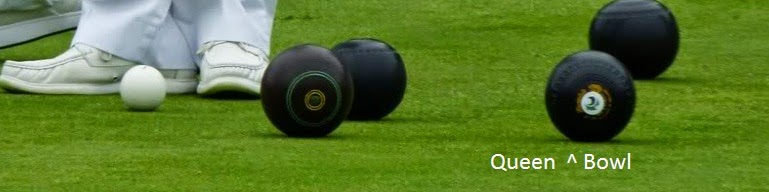
But the most valuable pieces in the chess game are the Queen and Pawns.  Where do you find them on your green?
A standing bowl (photo) can be as strong as a Queen in Chess. A small tap and it runs on it direction of roll. In the above photo it is easlier to tap ahead to knock over the bowl in front than draw to the jack. Also the fall of the bowl will probably be directly infront of the point bowl (behind)

Just last  weekend, I will participated in our  interprovincial competition between the four provinces of Nova Scotia, PEI, Quebec and New Brunswick. Sending each  their best bowlers to the Atlantic Lawn Bowls Tournment, we had 4 days of great game weather and very high competitive spirit. 


In 2011, as Lead on a "Triples Team" I was given the liberty  as lead to develop the head and define the jack distance or the Mat placement. We took Silver that year and were the only team to have beaten the Gold winner team from Quebec.

 I knew that I  could again develop those head which  prevent the opponent from gaining points, With this blog probably more suited to Skips, it is written also to show Leads the value of their bowls. If as the lead stands in the head at the end of the game,he can identify how the bowls which they played affected the game;  it becomes clear how valuable those first few bowls are to the winning of points.
David Bryan and Willie Wood 1995 Game ScoreCard

 
First, it is important to divide your game play into three parts. First 4 ends (up and Down if in Singles) are study and learning and we should accept small but continual point gains. 
 The second 4 ends are now time to apply your game strategy and attack the opponent at their weakness. (Using the information gained in the previous ends) This should be where the large points are gained.  The last 4 or 6 ends should be to maintain your point gain or recover what is needed. At this point one should be concern that each point given away is 2 points spread to regain.
 If team strategy change is necessary it should be done before the 10th end.

In any game of Lawn Bowls, the game strategy is different in each of thes sections of four ends, the start , middle four ends and the last four ends.  For example, by the time the last four ends are ready to play; all players now know their green and spead and can bowl to the jack with a good delivery. 

So strategy is best thought of as " If the jack is on the center line the contest becomes which team is the  best draw bowler team." 

However, if as lead it is possible in these last four ends the jack is rolled, trailed or displaced the jack; it becomes a new game.  A coach said to me once " Yes, roll the jack... at that far into the game you should know your green, your weight and be able to do it"

 An off-center Jack means the opponents must rediscovering the green during delivery and even using areas of the green which may not have been played when having a  jack line position of the jack.  Of course, this applies if my team mates are not "Line bowlers".  (line bowlers use a point on the Green or background to create their delivery line). This is usually discovered before the end of the first four ends of play and seen as the opponent moves the mat up and down the jack or centre line  to use this weakness to their advantage.


Of the  three Bowls a lead delivers one should definitely be shot and one should be within the head as a controlling bowl.  On the opponents preferred delivery side or controlling the best green delivery side.  The third bowl, which may be needed to replace a bowl which has been removed from the jack,  must be chosen carefully for its placement.  Maybe to balance the head.  Back with the opponents back or closing the takeout shot.


A "Game Rule" is  " If you are down your Bowls should be up in the head " indicate that the jack will probably move back and your best chance of getting a large number of points in an end; is to give your skip the opportunity to roll the jack to your Bowls behind the jack. 

This rule, also  applies to the second who must  complete to build the head with the bowls needed and based on what the lead has created.   Remember, your skip is in the head and know the situration, so he is organizing the bowls and asking from the head for the best bowls the second can delivered.  Sometimes, because of the opponents errors we have a free bowl which can be used to balance the head or gain another point.

Monday, September 15, 2014

Skipping the game " from the Mat"


Here in New Brunswick, Eastern Canada, the bowls game of "Fours" is not played other than to qualify for the Canadian Nationals.  When administering a head the skip attempts to build a structure of bowls, both defensive and offensive, which will guarantee winning points.

AThinkstock.com photo


Standing in the head, and directing bowls to different locations on the green around the jack may be a rather cruel method of building a head, because the lawn bowler on the mat can only guess at the actual location which is wanted.   Unless, you have bowled together as a team for several years and have a common understanding of what constituted a good head.

The reason I mention the games of "fours" in the above paragraph is that when the four bowls of the "lead end" are thrown by two individual bowlers, it is possible to define what the role of each bowler is preparing that head. Second, when there are two players doing the lead, the players will talk together and explain different options.  Also, each of the two leads in "fours" can be occupied to collect different information about the greens or the opponents.

photo bucket photo


Does the opponent lead have double sides draw ability, which hand, forehand or backhand, do they favor when given a tight draw to the jack.  When the green has a good draw side or a fast (narrow) side, what is the advantage of closing that side to the opponent.  Also there is the control of the mat.  Moving it a bit to save the greens or provide a good "Bowl receiving area". The area directly in front of the mat where your bowl makes initial contact with the green when doing a perfect delivery.

I have seen games of Bowls where at the end of 14 ends, I was surprise to discover that the skip did not know that the opponent had a left handed player. As lead, and as a left-handed bowler, I must be aware if the opponent are left or right handed. In a singles qualification tournament against a left-handed opponent, I did many of my bowl deliveries from a "off-step" stance.  Remember, every bowl that the opponent waste in finding his green and weight is an advantage and maybe a point for you.

 All bowlers learned from the opponent delivery, even if they don.t follow the same line. As we attempt to read difficulties in the green, as a good lead, I  should attempt to make the delivery to the jack as hard as possible for his opponents when placing the mat or jack.

Then there is the possibility that the skip has given the lead (leads in "fours") certain liberties like moving the mat or placing the jack at what the lead feels is an best offensive (or defensive) distance.
Remembering the greens and the advantages in the two directions can be a full time task, although many "fours" leads (or seconds) will say it is dull only bowling two bowls.

When bowling a short mat in the  direction of a closed background (clubhouse or fence trees) it is a different feeling than a short mat in an open background direction. A brought forward (to the hog line) mat creates a different feeling and challenge of a short jack with the wind behind then when the wind is in front of you.  So, as lead there is a lot to watch, learn, study and incorporate into the game. (if you are skipping (or team captain) from the mat). 

Never dull !!   even as a Lead because the building of the head starts with the your first 4 bowls of a "Pairs" lead and these 8 bowls (Opponents and  yours) create the way that whole rest of play will be played. Certainly, the value of a good lead is well known to skips or "team captains" after seeing how a early bowl has developed the game.

  At the Atlantic Bowls tournament last weekend ( Sept 5th) at the Sherwood LBC in Prince Edward Island, I saw Nova Scotia with a Pairs team , which was skipped from the mat.  This can be noticed as the lead bowler communicates (yells to the opponent skip in the head or goes to the head) to discuss something . Remember, certain game rules still apply as to when the lead can go to the head during a game. (after their third bowl).

In "Triples" Bowls which I played at the Atlantic Bowls it is a bit more difficult to skip the game from the mat. But us Canadians have seen this structure, for years in our national "Bowls like" game of Curling. Here, the team captain is  not the the last to deliver his "stone". In Curling for years, the team captain has continued to be the third (in the fours) and has been able to administer their game without difficult.  


Other end of green  (NB Flag, center)


In the game of Triples, it was more difficult. First, to advise the opponent skip that as team captain you are skipping from another position.
 I found that this was best done during the Trial End. After the flip of the coin and going to the mat with the opponent skip,  I had Laurance, whom would be in the head as skip on the mat as lead.
 
  As I walked up the green , or stood in the head with the opponent skip and received the trail end bowls, I said. 
 
 " Rule 37.8 requires me to tell you of any delegated responsibilities which I have given to players, which are normally my responsibility".  "Laurance, who is on the mat will be in the head as skip and delivering the skip bowls". This of course cause some strange looks until I finished with " As team captain or "Skip" if there are any problems of 37.1 (rules of Play) or 37.2 (Disputes) it will remain my responsibility". 
 
Following the Trail end bowls, Laurance went to the head as skip. 
 
In all six games played last weekend (of which I skipped from the head 2 games) there was no difficult. During the game, when necessary, and after my lead bowls were finished, I went to the head to help with the "second's bowl" and relax Laurance if it was necessary.

The reason for this play arrangement was that Laurance can get rather "hyper" in the head and it has happen that certain opponents find this weakness and attempt to work it into the game. (unnecessary Mind Games).  This is not very sportsmen like for those skips who play such mental games, but to some the winning of the game is the most important. 

 Of course, not all skips have the same mental strength. It does not help when after making a great shot, which Laurance is capable of doing,(why it is a good position for him) that he gloats about how good it was. It is not surprising that opponent skips become annoyed and find it necessary to say something. "Oh leave it alone, a bit" is common.
I have seen him get upset when the opponent skip said to him. " Until my bowls stops you are not permitted in the head and that includes talking to my bowls"  His excitement may have been  comments like.."stop. Stop.."  or "Fall over... Fall"  but the opponent skip comments of him talking to the bowls was enough to kill his entire game and calm. For the next several ends, he would go off mumbling to himself or be throwing things.  (A character fault which has improved over the past years)

Example of Head with all bowls in front


Actually, in one of the Atlantic bowls games, at about the 7th or 8th end the opponent skip said to me as we passed in mid-green.  "I hope you have medication for him as I think he is going to have a heart attack if he take the game any more serious". We laughed and I said.. " Thanks, I will spend more time in the head for the rest of the game"


In closing this Blogs, I will leave the reader with trick or message of picking up several points.  The rule of thought is " When you're Down  remember to have bowls up in the head ".  This rule suggests that if you have Bowls behind the jack which are not balanced by the opponent's, the jack may be rolled back to them and collect several points.


However, I discover a tight head collection, as I collected a total  seven points from what I call a " easy to draw delusion ". The distance from the jack which would win shot was easily a couple of feet, but a bad run in the green seem to kill any chance of the bowl arriving around the jack. 

 "There seems to be a hill around the jack" was the skips comment. 

 But remember, the jack is placed on the spot by hand not rolled to that spot and this sort of jack placement can happen.  "King of the Hill" jack placement .

  Of course, our first bowl was not on the jack but close enough and then delivered by a style of bias retained bowl. (When a bowler throws a bowl off-bias and it does not catch or actions it bias until the last few feet) When I immediately asked for a catch bowl out at 1 o'clock jack position,  the opponent skip felt it was possible to arrive closer to the jack than our shot, and continue to have his players attempt to draw to the jack.  The mat had been moved forward and the jack placement by hand was such that the green's irregularities  prevented a clean draw line to the jack. 


With only one Bowls behind the jack, and only one bowl on the jack, we built our head with Bowls at 15 to 18 in. in front.  The opponent feeling they could easily draw around the front Bowls and pickup the shot; therefore continued to attempt such a easy draw. 


As I came to the mat with the other skip, all our Bowls were around the jack with the exception of the one back bowl at 1 o'clock.  However, the opponents Bowls all over at the 11 o'clock position counting third or fourth but at quite a distance.  My first bowl was directly onto the frontal guard, raising it and its neighbor  bowl into the count.  The Second bowl was correctly on the center line about 3 ft. in front.  Preventing a runner into the head. 


As we had last bowl, I first thought that I would have to remove the opponents  bowl from being in the count.  However, an opponent's bad delivery had missed his  collection of bowls at 11 o'clock and removed his only counting bowl. therefore, my last bowl raised the left-handed guard at 7 o'clock; giving us a total of seven points.


This interesting collection of points was possible because with only one back bowl the opponent was attempting to draw into a large head and simply cut down the total count. Of course, his mistake takeout of his own bowl did not require me to do the take out.  Remember, always two bowls in the head else a surprise when the bowl counting third is removed. 

Of course, a lack of communication is to partly blamed because the opponents would certainly have made a change in strategy had they known they were down five or six points before playing that bowl.  Sometime, we see this lack of communication and it is a strategy  as skip,  to say nothing except to indicate to players  that their bowls are 18 in. are 2 ft. in front.

Next Blog,  Lead as ChessMaster.   


Friday, September 12, 2014

2014 Atllantic Bowls in PEI


2014 Atlantic Bowls weekend

2014 Atlantic bowls in Charlottetown PEI

Last  weekend, we the Maritime Competitive Bowlers, all  gathered together with the Quebec delegates for the 2014 Atlantic Bowls Championship at the Sherwood LBC in Charlottetown PEI..

Although the flag of Newfoundland flies with the other provinces on the edge of the Sherwood LBC green in the above photo, it is been quite a few years since a Newfoundland team has presented or participated.  Transportation is probably the cause, as the boat ferry from Newfoundland to Nova Scotia can be several hundred dollars to travel by car. (and that is just one way) But until the province withdraws officially it will still be waited upon for a team.

It was the provincial  Lawn Bowls Assoc of Prince Edward Island turn this year to  hosted the 42th Annual Atlantic Bowls, and everything was perfect.  Greens, organization and Weather all as planned.   Video of the 2013 games in Montreal is available on youtube. and although I did not see video cameras I hope that something of theses games appears online.
Quebec entry into 2013 Atlantic (video Youtube)


Of the four provinces participating, Quebec is the continual gold medalist and they are often followed by  Nova Scotia. These two provinces have multi clubs in their major city (Montreal and Halifax) area and therefore a great interclub system to build strong competitions.
New Brunswick enters behind Flag Bearer

While New Brunswick has four clubs at different levels of skill development with Fredericton the strongest, the remaining two provinces, PEI and Newfoundland has had for years had only  one club.(Although I am told the Peter Pan Club in Newfoundland has (or is about to) close. )

   New Brunswick, my home province has three areas of club development and during the last few years we have seen club
Our team for this years 2104 Atlantic
memberships decrease in most clubs. 
In the Moncton area where until last year there were three clubs it is now down to Centennial with their double green and Riverview which is a small (less than 20 members) club across the Pedicatcodia River.The third club in Shediac lost it greens and clubhouse to the municipality. The other two cities of New Brunswick, Fredericton and Saint John each have their one green clubs.Fredericton has done well with membership and fees while all the other NB clubs are struggling.


The province of Nova Scotia has all its clubs except one (Bridgetown)  in the Halifax area. This allows for much inter club competition and quality player development. 
2011 atlantics in Bridgetown
Bridgetown  which hosted the 39th Competition in 2011, has been struggling for the past years with low membership and high club maintance cost, but has accepted to again host this competition in 2015.

New Brunswick has about 40 players from the 4 active clubs gathering every second Wednesday to play intercity clubs games.which  build strong team.  Although with the exception of the Trites Team most interclub change every year. So is not unexpected that Quebec and Nova Scotia, who have 5 LBC clubs in their downtown area continue to have strong teams.. 

Over the next three blobs I will discuss various aspects of this year's competition.  First, " skipping from the mat " is becoming more common and as teams realize the value of a lead building the head. 


Thursday, September 11, 2014

Blogging stats reveal a lot

As I approach my 5000 pageview over the last 4 years of Blogs on Lawn Bowls, I am surprise of where the views and stats come throughout the world.
Recently, at the Atlantic Bowls Tournament in Charlottetown PEI, I discovered a Commemorate Bowl and posted a photo on my Twitter. As I follower bowls news from about 500 bowls clubs and individual throughout the world, I have 120 followers which are mostly lawn bowls elite and clubs.
Twitter acct of Springhiler

Recent tweets were about this bowl which commemorate the 1906 Canadian Tour and I would have thought that a lot of English followers would have been interested in it. The bowl was given to a George Cousin from the Illoa Lawn Club when Mr. Cousin returned from Canada.  The bowl was brought to Canada by his great great great grandson who had recently visited England and discovered it had been left to him a Canadian family member . One would have thought that the British readers of my twitter would be interest in the article of the 1906 Tour of Canadian Clubs.  Not so... The volume of readers for that 3 days were Canadian and Australian.

The viewers of the blog usually are generated from having read on twitter.  But not necessary.  As people search for specific items of interest it happens that they read the blog.  An example was when viewers from Russia were very active. It was because the blog about the 1905 Bowls tour had pictures and history facts about the RSM Empress of Ireland and the SS Drottningholm renamed from the SS Virginian.  These two vessels may have been the reason for blog viewers from Russia... I doubt if Lawn bowls is a popular sport there.

The stats of last month (August) show a recent development of interest in Spain and France.It may be the Cabrera LBC in Cabrera Spain which is the only bowls in Spain or it may be that some of my blog information about Petanque drew this interest from France
.  However, the articles of interest is in several  blogs on the subconscious ability in sports.

Blogging is more an attempt to share information and after 50 years of sports there is a lot that can be shared. Next Blog will be about the Atlantic Bowls Competition and a recent development of Skipping from the mat. (rather than the skip being in the head)  At least the Canadian Curling has been doing team captain or Skip from the third position for many years.